
Customer Retention as an Element of Digital Marketing Strategy
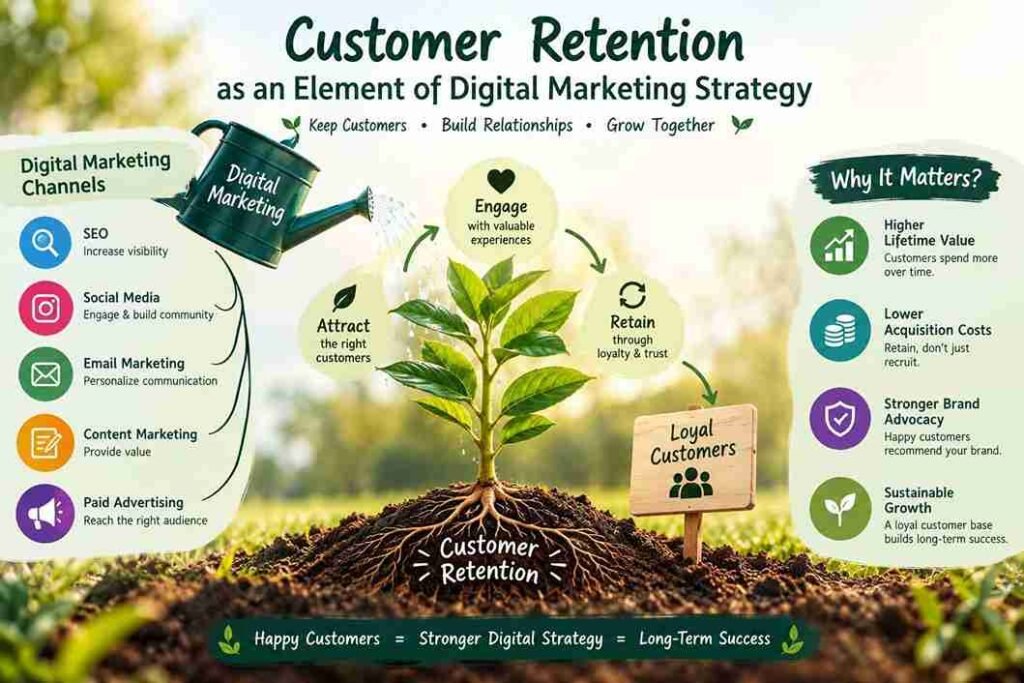
In today’s competitive environment, the acquisition of new customers is essential; nevertheless, customer retention is equally critical. Businesses use much of their resources on such activities as advertising, social networking, SEO, and other aspects of digital marketing to attract new customers. Nevertheless, the continued development of the business does not happen only through the attraction of new clients. An interaction with those customers that already purchased goods/services from the firm is very significant.
Customer retention is the capability of the firm to guarantee that current customers buy from the company once again.
Customer Retention Defined
Customer retention refers to the act of ensuring that existing customers are retained by making them purchase more from the business over a certain period of time. Unlike the usual act of trying to bring in new customers, businesses adopt various tactics of maintaining their previous customers.
For instance, one online business could send out customized product recommendations to their previous customers while another business providing services could adopt an email marketing strategy to keep their customers engaged. Such acts ensure that businesses are in touch with their previous customers.
Some of the ways through which customer retention can be achieved in the field of digital marketing include email marketing, social media interactions, personalized content marketing, loyalty programs, remarketing programs, and even customer support.
Importance of Customer Retention?
Customer retention may be regarded as an important factor in terms of growth and sustainability for a business. Marketing efforts spent in gaining new customers may comprise a number of factors like advertising, creation of content, and promotion, etc. It may be easier to convert customers who are already familiar with the brand name.
Therefore, a good digital marketing strategy must consist of both customer acquisition and customer retention elements.
1. Improves Customer Lifetime Value
Customer lifetime value is defined as the total lifetime value a customer will be able to add to the firm throughout the relationship. The lifetime value of a customer will be improved when he or she makes repeat purchases.
This can be done by a company using various digital marketing techniques to promote repeat purchases. These may include personalized discounts, product recommendations, newsletters, and loyalty schemes.
2. Fosters Customer Loyalty
Customer loyalty cannot be achieved through mere marketing efforts. Customers are more inclined to stick to a brand when they get quality products, good communication, and service all the time.
Social media interaction and individualized communications will allow businesses to retain their relationships even after their customers buy from them. It is when customers feel connected to the brand that they tend to patronize and recommend them.
3. Creates Less Reliance on Acquiring New Customers
An enterprise that invests all its efforts in attracting new customers will have to keep boosting its marketing and promotion activities. Good retention tactics provide an additional channel for growth.
Digital marketing allows companies to engage with current customers at different stages of their customer life cycle through various marketing techniques such as email campaigns, remarketing, education, and loyalty programs.
Digital Marketing and its Role in Customer Retention
Each digital marketing platform can help retain customers if it is implemented in a planned manner.
Email Marketing
Email marketing continues to be one of the ways through which businesses can retain their long-term customers. Businesses can deliver customized suggestions, product information, educational material, discounts, and other messages on the basis of the customers’ activities.
Rather than sending the same message to all the customers, the emails can be segmented according to past purchases, interests, geographic locations, or activities of the customers.
Marketing through Social Media
Social media is a platform that allows organizations to engage in direct marketing to existing customers via responding to their inquiries, interacting with their posts, and posting informative content.
Moreover, being constantly available on social media platforms ensures brand recognition among their customers.
Personalized Content
Personalization is an important part of current digital marketing. Personalized content that has something to do with the user’s past experience tends to get more engagement from users.
For example, the e-commerce company can recommend certain products based on the history of the user’s purchases. In the case of the software company, the tutorials can be about those features that the customer uses the most often.
Remarketing
Remarketing involves marketing to individuals who have at one point been on your website or online platforms. Although remarketing has been considered for converting visitors, it can also aid in retention through reminding past customers about certain products or services that they need.
But then again, remarketing campaigns must be well-targeted since repetitive exposure of irrelevant ads can negatively impact the customer’s experience.
Retention Strategies for Business Organizations
There are various digital marketing strategies that business organizations may utilize to enhance their retention.
Onboard the Customers Effectively
The connection between the customer and the organization does not stop right after making the sale. Effective onboarding will guide the customer on how to make use of the purchased product or services.
This can be done through welcome emails, tutorials, and other follow-ups.
Create a Loyalty Program
A loyalty program could help get customers to come back through offering rewards that would encourage customers to purchase again and again or engage more with the website.
The trick here is to keep things simple and rewarding instead of complicated.
Utilizing Customer Feedback
Feedback from customers can help companies identify problems and customer needs. This is possible through feedback that is obtained from surveys, reviews, social media, and other channels of communication.
The feedback can then be used by the company to improve its product and marketing communications.
Give Them Valuable Information
Not all content has to revolve around sales. Helpful content such as educational articles, tutorials, how-to’s, videos, and useful tips can be valuable regardless of whether your customers are interested in making purchases.
An organization will continue to be relevant by offering useful information to its customers.
Measurement of Customer Retention
Customer retention can be measured using appropriate metrics. Companies have the ability to measure customer retention rate, repeat sales rate, customer lifetime value, churn rate, email open rate, and returning website visits among others.
These metrics will help the marketer measure whether or not there is any creation of a loyal customer base through the digital marketing initiatives employed by the firm.
For instance, the company may attract thousands of visits on its website through some advertisements but only very few of them become returning customers. Increasing traffic alone may not necessarily be the solution.
Common Errors Made By The Organizations In Customer Retention
An error made by the organizations in customer retention is that of creating barriers in customer retention through excessive, irrelevant, or discount oriented communication.
The other error made by organizations in customer retention is that of treating all their customers in the same way. This is due to the reason that different customers have different needs and purchasing behavior. Segmentation and personalization will assist in enhancing relevance in marketing communications.
Not solving customer complaints can adversely impact the organization-customer relationship. It is essential for the organization to ensure quality customer service.
The Importance of Data in Customer Retention
Using data gives companies insights into the manner in which their customers use their product or service. This can be obtained from website statistics, purchase records, email interaction, and customer reviews, among other metrics.
For instance, if a company finds out that its customers keep stopping buying after making the first purchase, it should be able to look at why this is happening and devise a strategy to make it easier for customers. Data in digital marketing is not about increasing the number of emails.
Conclusion
Customer retention plays an integral role in sustainable business development. Although acquiring new customers remains critical, businesses must not forget about existing customers and invest in them as well.
An effective digital marketing approach could be used by businesses for maintaining customers via email marketing, social media, personalized content, remarketing, loyalty programs, and useful educational content. Once all those activities are backed up by customer feedback and performance data, the formation of strong customer relationships and their purchase repetition becomes possible.
In the end, customer retention is not simply about motivating customers to make a purchase once again but about giving them a reason for returning to the same brand.In today’s competitive environment, the acquisition of new customers is essential; nevertheless, customer retention is equally critical. Businesses use much of their resources on such activities as advertising, social networking, SEO, and other aspects of digital marketing to attract new customers. Nevertheless, the continued development of the business does not happen only through the attraction of new clients. An interaction with those customers that already purchased goods/services from the firm is very significant.
Customer retention is the capability of the firm to guarantee that current customers buy from the company once again.